
Can Genicular Artery Embolization Help Relieve Knee Osteoarthritis Pain Without Surgery?

Written & Medically reviewed by Dr. Arjunlokesh Netaji, MD, DM (Interventional Radiology), EBIR — Consultant Neuro & Vascular Interventional Radiologist, Chennai.
Ask someone with knee arthritis why they finally came to a doctor, and the answer is rarely the X-ray. It's the temple steps they've stopped climbing. The floor they can't sit on at family functions. And the long nights of turning over, unable to settle.
Knee replacement is the answer many have heard about, and many aren't ready for it. Some are scared, and some have other illnesses that make surgery riskier. For selected patients there is another option, genicular artery embolization, or GAE. It's done through a needle puncture, with no cut. It is a fairly new treatment for the knee.
Why Knee Osteoarthritis Causes Pain
Think of cartilage as the cushion lining your knee joint. In osteoarthritis, it thins out over the years. The knee gets stiff, especially in the morning, though that stiffness usually wears off in about half an hour.
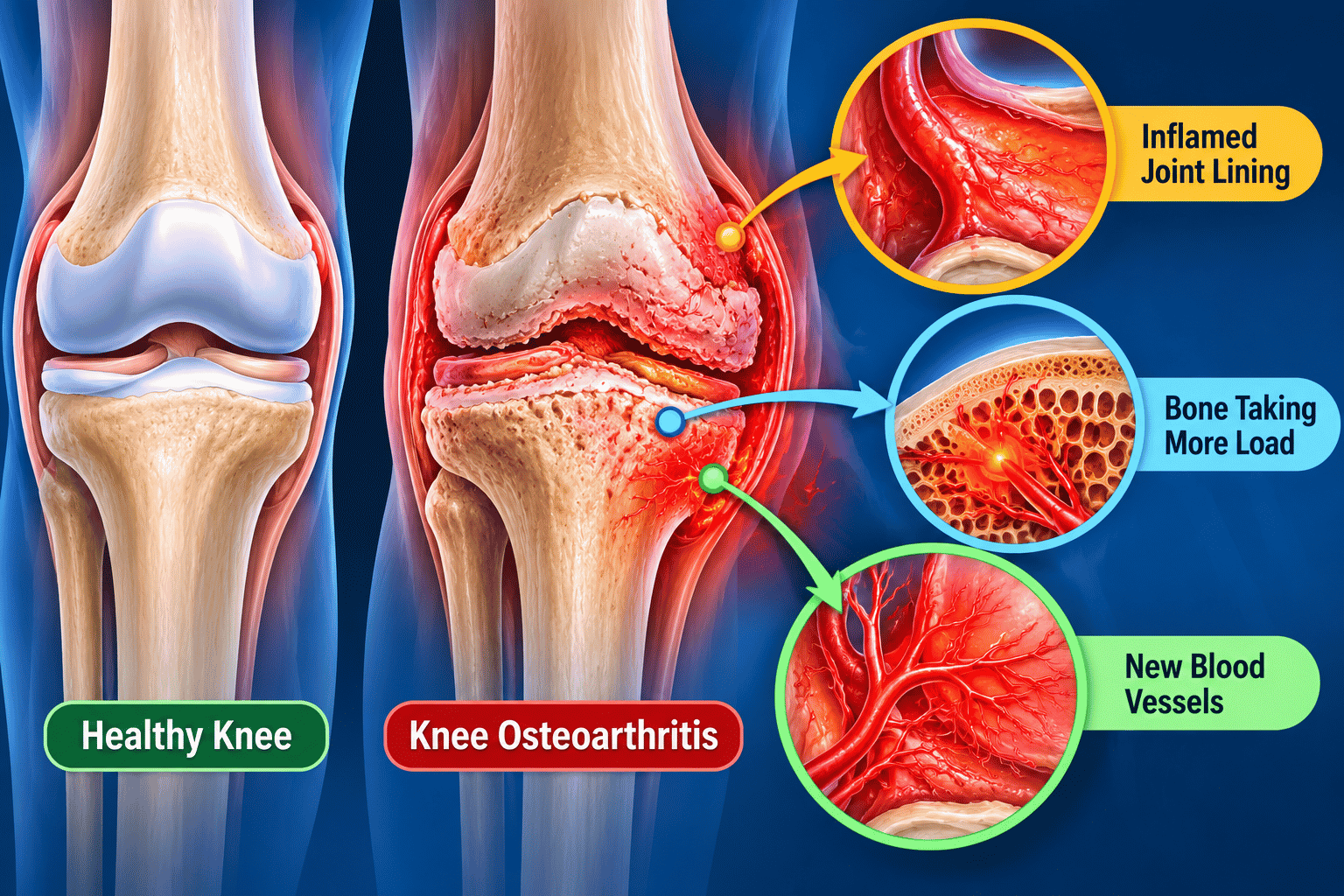
But cartilage itself has no nerves of its own. It can't feel pain. The source lies elsewhere, in the tissues next to it:
- the joint lining (the synovium), which becomes swollen and angry
- the bone under the cartilage, which is full of nerves and ends up taking more load
- tiny new blood vessels that sprout into the inflamed lining and seem to keep the swelling going
GAE goes after that last one.
What Is Genicular Artery Embolization (GAE)?
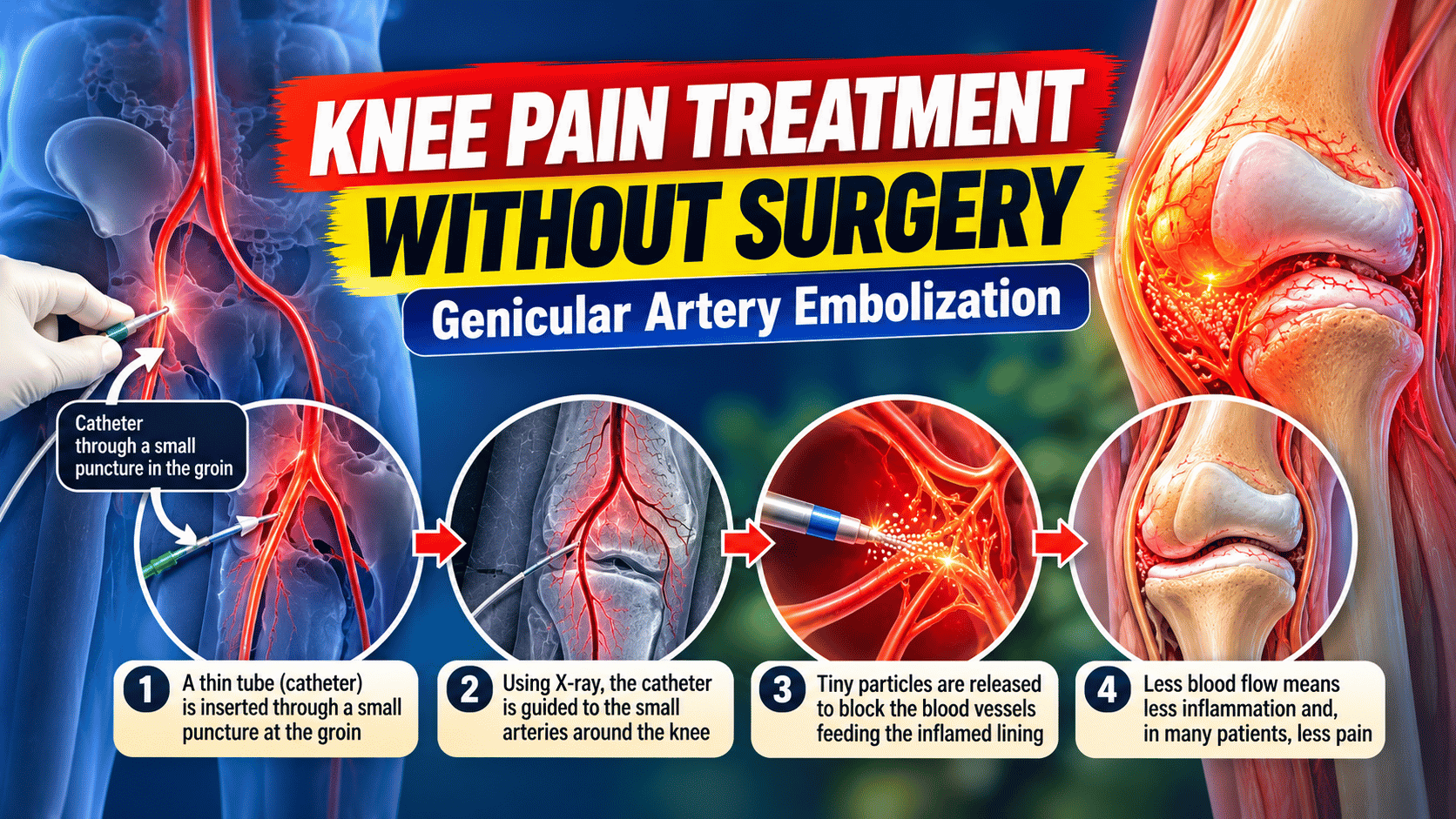
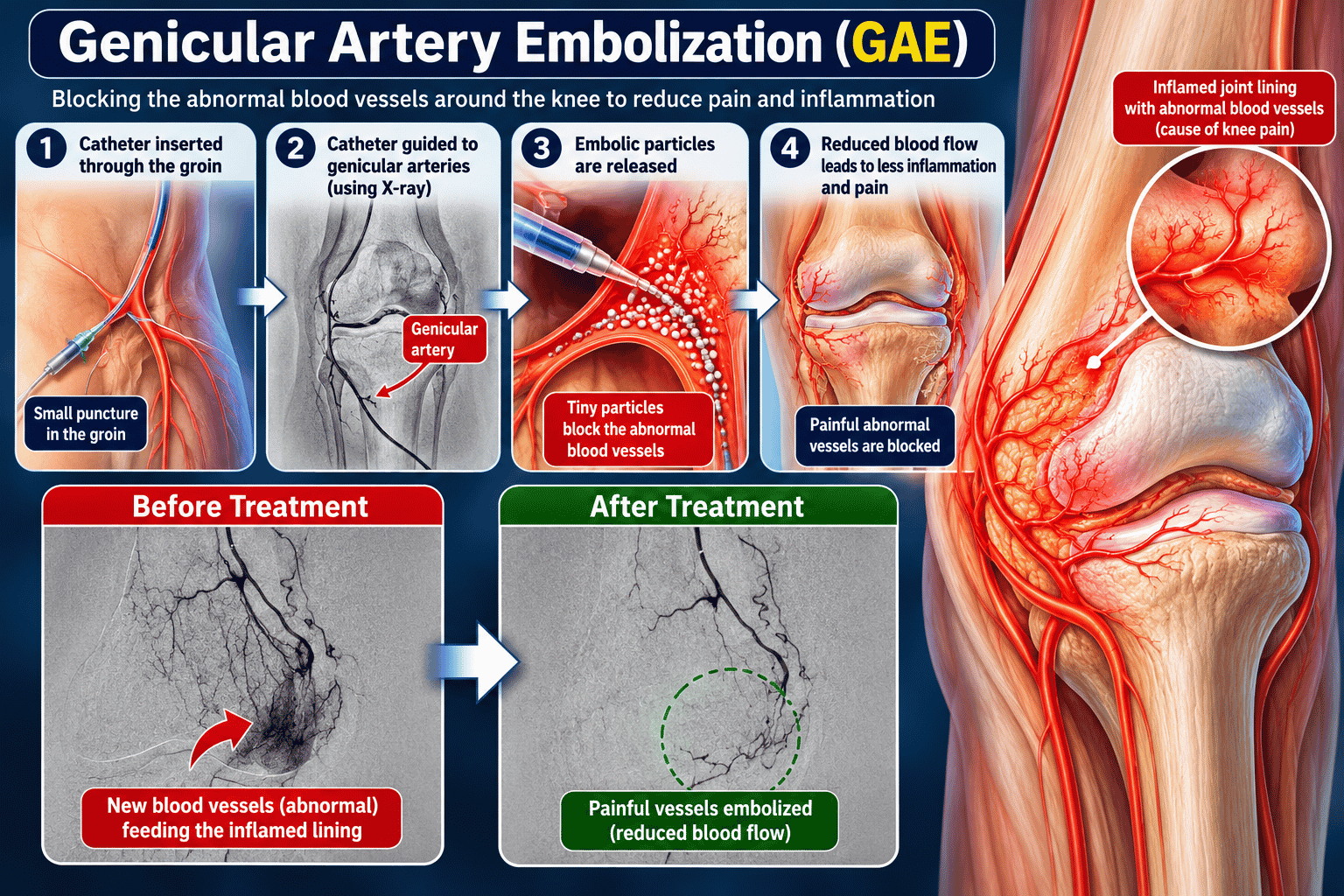
A catheter, which is a very thin tube, goes in through a small puncture at the wrist or groin. Using live X-ray, we steer it down to the small arteries around the knee. Once it's there, we release tiny particles that block the vessels feeding the inflamed lining. This blocking is what doctors call embolization. Less blood flow means less inflammation and, in many patients, less pain.
None of this is new in radiology. The same method has been used for years in uterine fibroid treatment without surgery. What's new is using it on knees. And it has limits. GAE can't regrow cartilage or can't straighten a knee that has become deformed. GAE is solely for the relief of pain which many would want desperately.
What Happens During the GAE Procedure?
Before the procedure
- A knee X-ray and blood tests.
- A full list of your medicines.
- Please don't stop any medicine yourself. We'll tell you what to pause.
On the day
- You stay awake. Once the skin is numbed you'll feel a pinch and not much else. Some centres add a little sedation.
- The procedure usually takes one to two hours.
- You rest for a few hours afterwards, flat on your back if we went in through the groin.
- The knee may feel warm and sore.
- Most people go home the same day, some the next morning.
Who Is a Good Candidate?
Don't judge your knee by its X-ray. Some people have a terrible-looking film and walk fine, while others with a mild film can't sleep for the pain. So the doctor's examination carries as much weight as the film.

GAE may be an option if:
- the pain has been there for months
- tablets, physiotherapy and injections haven't done enough
- the X-ray shows mild or moderate arthritis.
- you would rather not have an operation, or surgery isn't possible for you
It's usually not suitable with advanced arthritis, an infection, pregnancy, poor kidney function, poor circulation in the leg, a bleeding problem, or when the pain comes mainly from rheumatoid arthritis or gout. A past reaction to contrast dye? Tell us. It needs planning, but it isn't always a no.
Potential Benefits and Risks of GAE
What can GAE offer? Significant pain relief in appropriately selected patients, without major surgery or a prolonged hospital stay. What it hasn't shown is that it keeps a knee replacement away.
Common and mild :
- A bruise at the puncture site
- A sore knee for a few days
- A faint patch of skin colour change that fades
Rare :
- Bleeding or infection at the puncture site
- A reaction to the dye, or strain on the kidneys
What Is the Recovery Time After GAE?
Relief doesn't arrive overnight. If GAE is going to work, the pain usually settles slowly over several weeks. Rest for the first two days, walk gently after that, and skip heavy lifting and hard exercise for about a week. That's the general advice. Follow your own doctor's instructions.
Phone the hospital if you notice
- more swelling, redness or leaking at the puncture site
- fever
- blisters or dark skin around the knee
Go to emergency care right away if
- the leg turns cold, pale or numb
GAE Compared With Other Treatments
Let's be clear: GAE doesn't replace knee replacement when the joint is badly damaged. It suits the middle ground: mild to moderate arthritis that keeps hurting despite simpler measures.
|
Treatment |
Best for |
|
Physiotherapy and weight management |
Early to moderate arthritis; the foundation of care |
|
Medicines and gels |
Mild to moderate pain |
|
Steroid injection |
Brief relief during a flare-up; doing it again and again is discouraged |
|
Hyaluronic acid or PRP injections |
Mild to moderate arthritis; benefit varies |
|
Nerve radiofrequency ablation |
Pain that persists despite other treatment |
|
GAE |
Mild to moderate arthritis, not helped enough by other treatment |
|
Knee replacement (partial or total) |
Advanced arthritis with severe joint damage |
When Should You See a Knee Specialist?
A few weeks of knee pain is reason enough to see a doctor. It's more urgent if the pain:
- wakes you at night
- makes stairs hard
- has stopped responding to tablets and injections
One request: please don't keep raising your painkillers on your own. Anti-inflammatory tablets taken every day can hurt the stomach and kidneys and push blood pressure up. A gel applied on the knee is often a safer first step.
Common Questions
1. Does genicular artery embolization work for knee osteoarthritis?
Yes. GAE can significantly reduce knee pain and improve mobility in appropriately selected patients, helping some patients postpone knee replacement surgery.
2. Is GAE safe?
Yes. GAE is a minimally invasive, non-surgical procedure with a good safety profile. Most patients recover quickly, and serious complications are uncommon.
3. How long does the relief last?
Many patients experience lasting pain relief, with studies showing benefits for 1–2 years in some patients. Results vary depending on the severity of arthritis.
4. Can I still have a knee replacement later?
Absolutely. GAE does not prevent future knee replacement surgery. It offers an opportunity to manage pain without undergoing major surgery immediately.
5. Can GAE be repeated, or done on both knees?
Yes. Both knees can be treated when appropriate, and repeat GAE may be considered if pain returns, depending on clinical evaluation.
6. What does it cost, and will insurance cover it?
GAE costs vary depending on the hospital and treatment requirements. Insurance coverage depends on your policy, and our team can assist with cost estimates and insurance verification.
Speak to the Doctor About Your Knee
If your knee is deciding what you can and can't do in a day, get it looked at properly before you pick a treatment. At the consultation we go through your scans, examine the knee, and tell you plainly whether GAE is right for you or whether something else would help more.
Book a consultation with Dr. Arjunlokesh Netaji at Kauvery Hospital, Vadapalani, to find out whether genicular artery embolization in Chennai is right for you.
Last Medically reviewed:(29/10/2026) -Dr. Arjunlokesh Netaji