
Thyroid Nodule Treatment Without Surgery in Chennai: A Non-Surgical Alternative to Open Thyroid Surgery
Written & Medically reviewed by Dr. Arjunlokesh Netaji, MD, DM (Interventional Radiology), EBIR — Consultant Neuro & Vascular Interventional Radiologist, Chennai.
A patient sees it while looking at the mirror. Or a radiologist flags it on a scan ordered for something else entirely. Either way, once "nodule" gets paired with "surgery," most people stop listening to whatever comes next.
That reaction is understandable — but increasingly outdated. A growing number of thyroid nodules in Chennai are now managed without an operating table at all. Dr. Arjunlokesh is among the interventional radiologists offering this shift: treating the nodule through imaging and a needle, not a scalpel.
What is a Thyroid Nodule?
The thyroid sits low in the neck, wrapped around the windpipe. Small lumps form within it over the years, often without anyone noticing.
Nodules typically surface one of two ways:
- Felt during self-exam or a routine physical examination.
- Found incidentally on an ultrasound or CT scan ordered for something unrelated
Not all nodules behave the same way:
- Solid — made of thyroid tissue
- Cystic — fluid-filled, usually easier to manage
- Complex — a mix of both
Roughly 90 to 95% turn out benign. That's reassuring, but it isn't a substitute for a proper workup. A nodule that "feels fine" still needs ultrasonography, and usually a FNAC (Fine Needle Aspiration Cytology), before anyone can rule out cancer.
For decades, a symptomatic nodule meant one answer: open surgery, general anesthesia, a hospital stay, and a scar. That backdrop is exactly why patients are now asking about alternatives before booking an operation.
Why Fewer Patients Are Choosing Surgery First
Surgery still has a clear role. Confirmed cancers and malignancy-suspicious nodules belong in an operating room.
Where the calculus shifts is the more common scenario — a benign nodule causing pressure or cosmetic concern. Here, the trade-offs of open surgery start to look disproportionate:
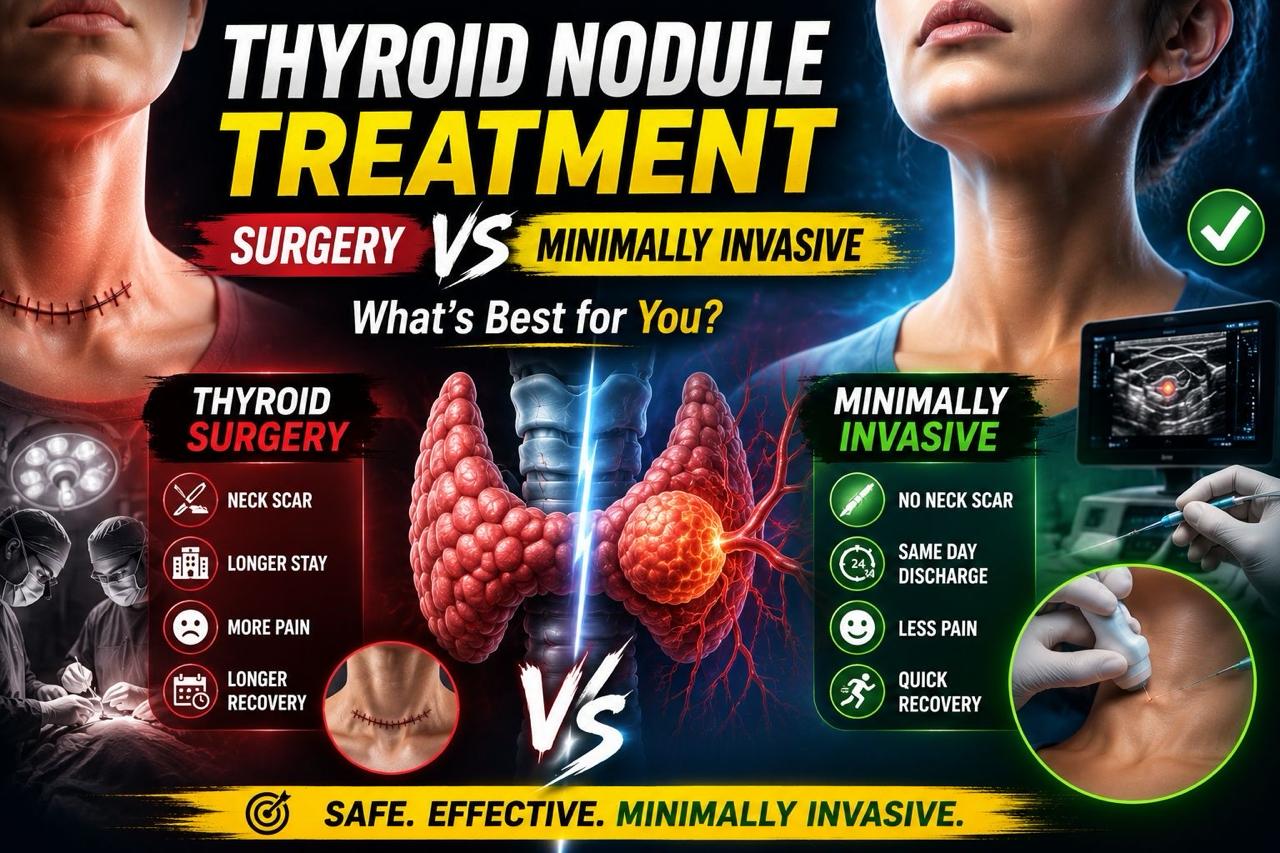
Alt text: Comparison of thyroid surgery vs radiofrequency ablation (RFA) for thyroid nodules, showing scarless minimally invasive thyroid treatment versus traditional open thyroid surgery in Chennai.
- A visible neck scar, occasionally keloid-prone
- A small but real risk to the nerves controlling the voice
- Three to four days in hospital, plus a longer recovery at home
- A chance of lifelong thyroid hormone replacement if too much gland tissue is removed
Non-surgical care exists to close exactly this gap: treat the nodule, spare the rest of the gland.
How Radiofrequency Ablation Works
Strip away the terminology and RFA is simple to describe:
- A thin probe is guided into the nodule under continuous ultrasound
- If any voice nerve is nearby, saline injection around the nerve is performed to protect it from heat.
- Radiofrequency energy heats the target tissue from within
- The probe moves in small increments — the "moving-shot" technique — so the nodule is treated evenly while nearby structures are preserved.
- Local anesthesia keeps the patient awake and comfortable. You would keep talking to us throughout the duration of the procedure.
RFA doesn't shrink a nodule overnight. Dr. Arjunlokesh tells patients to expect the first visible change around one to three months in. Shrinkage often continues for up to a year, with results generally holding steady for years afterward. One to three months is the start of the response, not the end of it.
There's no incision — just a puncture the size of a needle used for a blood draw. Only the nodule is targeted; healthy tissue is left alone.
Who Actually Qualifies?
Not every patient with a nodule is a good candidate. Good candidates typically have:
- A nodule confirmed benign by FNAC or biopsy
- Visible swelling, pressure, or genuine cosmetic concern
- No suspicious features on ultrasound
- A clear preference to avoid surgery where it isn't medically necessary
A complete workup — ultrasound, thyroid function tests, usually a FNAC or biopsy — always comes first forThyroid Nodule Treatment Chennai. Any clinic willing to skip that step is one to be wary of.
What Happens During the Procedure
A typical session:
- Local anesthesia around the nodule
- Ultrasound confirms probe position throughout
- If any voice nerve is nearby, saline injection around the nerve to protect it from heat.
- Energy delivered in short to the nodule, controlled bursts
- 20 to 30 minutes total, depending on nodule size and number
- Brief rest, then home the same day
Open surgery, by contrast, still means general anesthesia and two or three days in hospital, regardless of how small the nodule is.
Surgery vs. RFA
Factor | Open Surgery | RFA |
Anesthesia | General | Local |
Incision | Visible scar | Needle puncture |
Hospital Stay | 2–3 days | Same-day |
Thyroid Function | May need hormone replacement | Typically preserved |
Pain | Moderate to high | Minimal to Mild |
Downtime | 1–2 weeks | 1 day, at the most |
For a benign, symptomatic nodule, this table explains the shift in patient preference. Less hospital time. Less time off work. Fewer downstream complications to manage.
Where RFA Falls Short
No procedure is risk-free, and RFA doesn't suit every nodule. Patients should know:
- Bruising or swelling at the puncture site is common and settles within days
- Transient hoarseness can occur near the laryngeal nerve — usually temporary; permanent change is rare
- Larger nodules often need a planned second session. That's normal protocol, not a failed first attempt
- Very large or deep nodules might be suitable for Thyroid artery embolization, which is another minimally invasive technique to treat thyroid nodules without surgery.
- Complete disappearance isn't the goal. Most well-selected nodules shrink by half or more within 6 months and remain visible, just smaller, on follow-up scans.
None of this argues against RFA for the right patient. It argues for the same scrutiny anyone would apply before agreeing to surgery.
Before You Decide
- Insist on a FNAC-confirmed benign diagnosis before ablation
- Request documented baseline and follow-up size measurements
- Expect a real timeline: early shrinkage by one to three months, full results closer to 6 months to a year.
Common Questions
Does RFA hurt?
Most patients feel mild warmth, but not pain. The anesthetic injection is usually the part with a minor discomfort — after that, most people stay awake and comfortable throughout.
How soon will the nodule shrink?
Noticeable shrinkage by one to three months, continuing gradually for up to 6 months to a year.
Will I need thyroid medication afterward?
Unlikely, since RFA spares healthy tissue unlike surgery. But if a large part of the gland was already affected, some monitoring or medication may still be needed if already taken previously.
My nodule is large. Can RFA still work?
Often, yes — though larger nodules may need a second session for full effect. Very large or deep nodules might be suitable for Thyroid artery embolization, which is another minimally invasive technique to treat thyroid nodules without surgery.
Does insurance cover it?
Depends on your insurer, policy, and sometimes your country's regulations. Confirm with your provider and clinic before scheduling. Many insurance companies do cover these latest procedures in the present times.
Can a treated nodule return?
Highly unlikely, but a new nodule can form elsewhere in the gland — which is why periodic follow-up still matters.
Getting a Second Opinion
If a doctor has already used the word "surgery," it's worth getting a more specific second opinion first. Ask what a non-surgical option would look like for your particular nodule, based on your own scan and FNAC, not a generic answer.
Considering RFA instead of surgery? Book a consultation with Dr. Arjunlokesh Netaji in Chennai. Your scans and FNAC reports will be reviewed personally, giving you a clear, realistic picture of what's possible in your case — with or without surgery.
Last Medically reviewed:(Date) -Dr. Arjunlokesh Netaji
References :
Papini E, Monpeyssen H, Frasoldati A, Hegedüs L. 2020 European Thyroid Association Clinical Practice Guideline for the Use of Image-Guided Ablation in Benign Thyroid Nodules. Eur Thyroid J. 2020;9(4):172-185. doi:10.1159/000508484. PubMed
Kim JH, Baek JH, Lim HK, Ahn HS, Baek SM, Choi YJ, et al. 2017 Thyroid Radiofrequency Ablation Guideline: Korean Society of Thyroid Radiology. Korean J Radiol. 2018;19(4):632-655. Pubmed
Orloff LA, Noel JE, Stack BC Jr, Russell MD, Angelos P, Baek JH, et al. American Thyroid Association Statement on Ablation Techniques for Benign Thyroid Nodules. Thyroid. 2023;33(4):406-427. Pubmed
Mauri G, Pacella CM, Papini E, Solbiati L, Goldberg SN, Ahmed M, et al. Image-Guided Thyroid Ablation: Proposal for Standardization of Terminology and Reporting Criteria. Cardiovasc Intervent Radiol. 2019;42(5):611-618. Pubmed